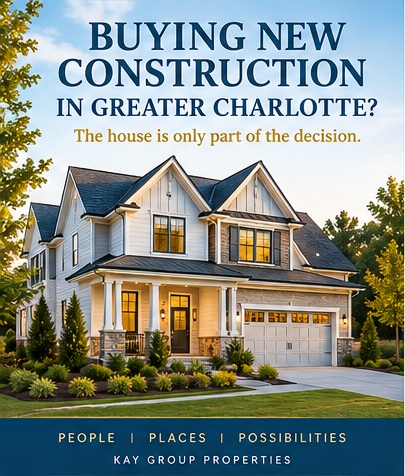
Buying New Construction in Charlotte, NC: What Buyers Should Know Before Visiting a Builder
Model homes are exciting. But the decisions that matter most often happen before you choose the countertops. Kay Group Properties helps Greater Charlotte buyers look at the whole move: the home, homesite, builder process, upgrades, inspections, incentives, timing and the home you may need to sell or rent.
Before You Tour a Charlotte Model Home, Look at These 6 Things
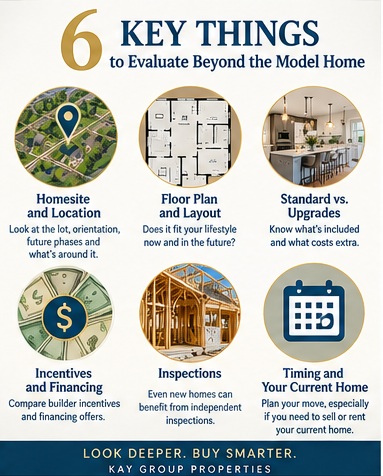
Talk to your agent first
Registration policies vary. Start the representation conversation before visiting or registering.
Model vs. actual home
Ask which finishes, structural choices and design features are standard, upgraded or specific to the model.
The homesite
Consider orientation, slope, neighboring lots, roads, common areas and future phases.
Incentives
Compare the full economics, including financing terms and conditions attached to incentives.
Independent inspections
A new home is still a complex product built by many trades. Another qualified set of eyes can matter.
Your whole move
If you already own a home, plan the purchase, sale or rental and moving timeline together.
What Years of Parade of Homes Judging Have Taught Us to Notice
Years of participating in Home Builders Association of Greater Charlotte Parade of Homes judging have given Kay Group Properties repeated opportunities to study new-home layouts, design choices and the practical details that affect how a home lives.
That experience reinforces a simple buyer lesson: the details that photograph beautifully aren't always the details that matter most on an ordinary Tuesday.
Does the Builder’s Onsite Sales Representative Represent the Buyer?
For North Carolina consumers, the North Carolina Real Estate Commission provides information about real estate brokerage and agency relationships.
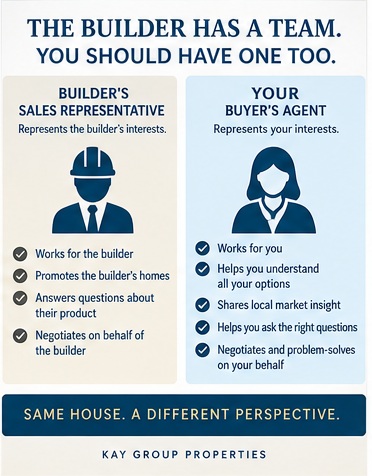
The Builder Has a Team. Think About Who Is on Yours.
Buying a new construction home can involve much more than choosing a floor plan and finishes. You may be comparing communities and homesites, making upgrade decisions, reviewing incentives, coordinating inspections, following construction milestones, arranging financing and deciding what to do with the home you already own.
Most buyers do this only a few times in their lives. An experienced real estate agent sees transactions, negotiations, timelines and problems much more often. That perspective can help a buyer ask better questions, spot items that deserve attention, keep the process moving and help facilitate solutions when issues arise.
Buyer-agent compensation is negotiable. A builder may offer compensation toward a buyer-agent fee in a particular transaction, but programs vary; discuss representation, services and any fee with your agent before touring.
What can a buyer's agent help with?
- Compare builders, communities, floor plans, homesites and available options.
- Separate model-home presentation from the features included in the home you are actually buying.
- Help evaluate incentives and transaction choices in the context of your overall goals.
- Coordinate communication, dates, inspections and the many moving pieces between contract and closing.
- Help identify issues that need attention and facilitate communication toward a solution.
- Plan the sale or rental of your current residence alongside the new-home timeline.
It's Brand New. Why Would I Need an Inspection?
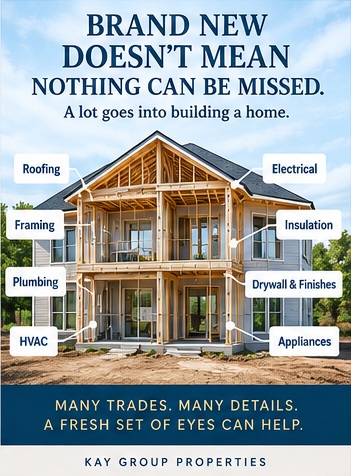
A common question is: “Doesn't the builder inspect the home? And don't I have a warranty?”
New homes go through construction oversight and applicable permitting and inspection processes. But a home is a complicated environment built by many trades and contractors. Even a conscientious builder can have something missed. A builder walkthrough, a warranty and an independent inspection each serve different purposes.
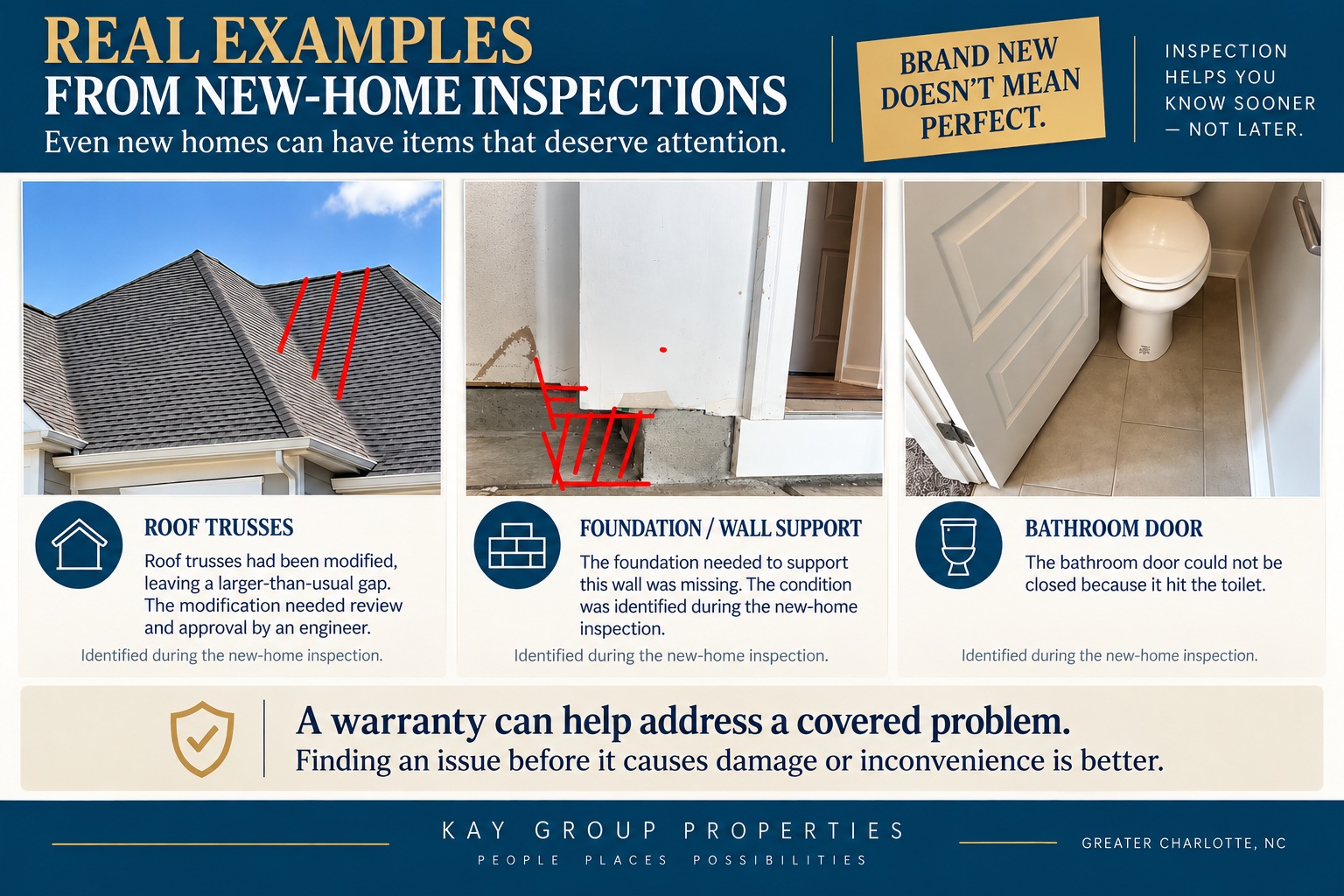
These are real examples identified by independent inspectors in new-construction homes where Kay Group Properties represented buyers in the Greater Charlotte area. These examples are shared to show the value of having another qualified set of eyes on a new home—not to evaluate or rank a builder. Technical findings and recommendations come from the appropriate inspection or engineering professionals.
Roof trusses
Roof trusses had been modified, leaving a larger-than-usual gap. The modification needed review and approval by an engineer.
Foundation / wall support
The foundation needed to support a wall was missing. The condition was identified during the new-home inspection.
Bathroom door
The bathroom door could not be closed because it hit the toilet.
A warranty and an inspection solve different problems.
A warranty may provide a process for correcting certain covered problems. An independent inspection can help identify conditions that deserve attention before they cause additional inconvenience or damage. Depending on the construction stage, buyers can discuss pre-drywall, final and warranty-period inspections with a qualified inspector.
New-Construction Buyer Experience Across Greater Charlotte
Kay Group Properties has helped buyers with new-construction purchases across the Charlotte region. Examples of areas where we have represented new-construction buyers include Charlotte, Huntersville, Denver, Pineville, Waxhaw, Indian Trail and Belmont in North Carolina, as well as Indian Land, South Carolina.
The four Parade of Homes examples below happen to be in Huntersville. They are a small firsthand sample and are not intended to represent every builder, community, price point or area in the Greater Charlotte market.
4 Homes. 4 Builders. 4 Buyer Lessons.
During the 2026 Parade of Homes judging process, we toured four homes from four builders. These are examples from a small sample—not rankings and not a claim about every Greater Charlotte builder, community or price point.
Madison-Simmons Homes — Townes at Maxwell
Laurel, Huntersville. Natural light, private bathrooms and a primary-suite balcony reinforced a simple lesson: don't judge a townhome only by bedroom count. Study how the square footage lives.
JPOrleans — Coventry Glen
Garrison, Huntersville. A main-level office and guest suite, spacious loft and generous primary storage showed why square footage tells you size—but the layout tells you function.
David Weekley Homes — North Creek Village
Gardengate, Huntersville. A two-story townhome with detached two-car garage and courtyard arrangement was a reminder to compare the actual living experience, not simply the “townhome” or “single-family” label.
Empire Communities — Harris Farms
Kingston, Huntersville. Flexible loft space and the relationship between garage, pantry/laundry and living areas highlighted the importance of walking a home as if you already live there.
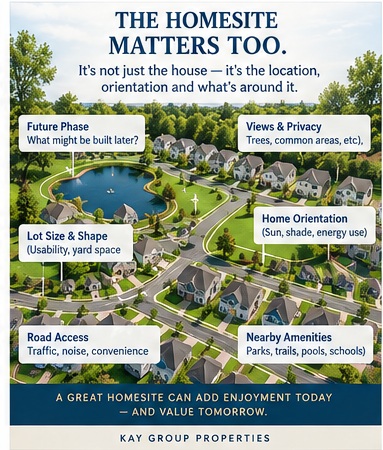
Look Beyond the House: Evaluate the Homesite
The same floor plan can feel very different depending on where it sits in the community. Consider orientation, slope, neighboring lots, roads, common areas, future phases and what may eventually be built nearby.
Model Home: What You See vs. What You Need to Ask
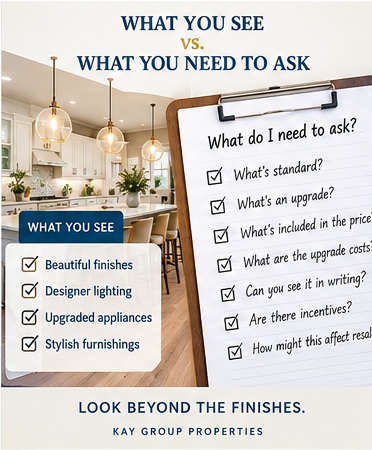
Model homes are designed to showcase possibilities. Ask which features are standard, which are upgrades, what is included in the specific home you are considering, and how those choices affect the final price.
The 10-Minute Model Home Test
Model homes are designed to make a great first impression. Give yourself ten minutes to look past the presentation and imagine ordinary life.
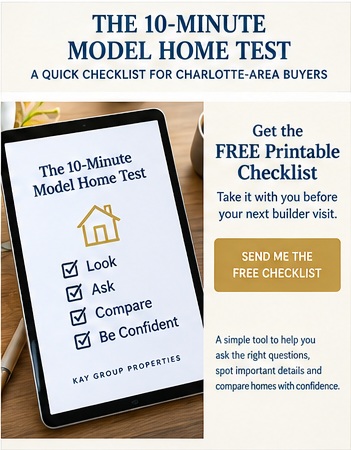
Take the Checklist With You
Get the printable 10-Minute Model Home Test before your next builder visit. It gives you the questions and quick checks to use while you walk the model.
Get the Free 10-Minute Model Home Checklist
Charlotte New Construction FAQ: Questions Buyers Ask Us
Does it cost me anything to use a buyer's agent when buying new construction in Charlotte?
Often it is at no cost to you, the buyer, but it depends on the builder's program for the specific home. In every Charlotte-area new construction purchase we handled in 2025 and so far in 2026, the builder paid our commission. We discuss compensation as part of our buyer agency agreement before you tour, so you know how it works for your situation before you visit a builder.
Can I negotiate the price of a new construction home in Charlotte?
Sometimes, but builders usually protect the listed price and give ground through other terms: closing cost credits, design or upgrade credits, rate buydowns, and lot premium adjustments. You typically have the most room on completed or nearly completed homes the builder wants to sell, and the least on homes not yet started in high-demand communities. Get every concession written into the contract, because a promise from the sales representative that isn't in the contract may not be honored. Compare total cost, not just price: a lower price tied to a higher interest rate can cost more overall.
What costs should I expect beyond the base price of a new construction home?
Ask for a written cost breakdown of the specific home, or of a completed comparable home, not just the base price. Common additions are the lot premium, structural options, design-center upgrades, exterior items such as landscaping, fencing, irrigation and patios, and appliances or fixtures that aren't standard. Also ask about HOA dues, what they cover, and any one-time fees due at closing. Model homes show upgraded features, so confirm what's included in yours.
What builder incentives are common in Charlotte, and how do I compare them?
Common forms are closing cost credits, mortgage rate buydowns, design or upgrade credits, and price reductions on specific homes. Offers often differ by home: a completed home the builder wants to sell may carry different terms than one not yet started. The usual catch is conditions, such as using the builder's preferred lender or title company, or closing by a certain date. To compare fairly, get a loan estimate from the preferred lender and from an outside lender, then compare total cost: price, interest rate, closing costs, and the value of any credits. Incentives change often, so confirm the terms for your specific home and contract date in writing.
How long does it take to build a new construction home in the Charlotte area?
It depends more on the stage of the home than on the builder. The same community can offer homes ready in weeks and homes that are more than a year away.
| Stage | What it means | Typical timing | Main thing to watch |
|---|---|---|---|
| Move-in ready | Finished, or nearly finished | 2–4 weeks to closing | Fewest choices, least uncertainty |
| Under construction | Framed or in progress | 4–6 months | Which finishes are already locked |
| Lot ready, to be built | Lot is available, construction hasn't started | 6–12 months, often under a year | Build queue, selections deadlines |
| Future phase | Phase not yet open, and permits or approvals may not be complete | Uncertain, may be well over a year | Timeline can shift; nothing is guaranteed |
Ranges reflect Kay Group buyers' purchases over the past 24 months. Individual homes and builders vary.
What's the difference between a move-in ready home and a lot that's ready to build?
A move-in ready home (often called a quick move-in) is built or nearly built, so you know the finishes, the closing date is close, and there are few decisions left. On a lot that's ready to build, roads and utilities are in place and you can choose a plan and finishes, but construction starts after you contract, so you wait through the build and your date depends on the builder's schedule.
What if I'm interested in a phase that hasn't opened yet?
Treat the timeline as an estimate, not a promise. A future phase may still need infrastructure completed and permits or approvals, and each of those can move the date. Ask the builder what's already approved, what's still pending, and what happens to your deposit and price if the schedule slips. Keep in mind that a long timeline also affects your mortgage rate lock and your current housing plans.
What should I get in writing about the completion date?
Ask for the estimated completion date, how the builder defines "complete," what extensions the contract allows, and what remedies you have if it slips. Then align your rate lock and your sale or lease end date to that window, not to the best-case date.
What does a builder warranty cover on a new construction home in Charlotte?
The most common structure we see is a two-year systems / ten-year structural warranty: about two years of coverage on major systems such as plumbing, electrical and HVAC, and ten years on major structural defects. Some builders add a more inclusive first year that also covers workmanship and materials. Others schedule a one-year walkthrough before the two-year systems / ten-year structural coverage takes over. Terms differ by builder, so ask for the actual warranty document before you sign. Look for what's covered and excluded, how to submit a claim, who does the repairs, and whether a third-party warranty company stands behind the builder's promise. A warranty gives you a process for fixing covered problems after closing. It doesn't replace an inspection before closing.
What happens to my deposit if the builder is delayed or the sale falls through?
It depends on the contract, so read it before you sign. Ask how much is due and when, who holds the deposit, which conditions make it refundable (such as a financing contingency or a completion date that slips past a stated limit), and what happens to your price and rate lock if the schedule moves. Builder contracts are usually the builder's standard form and can be hard to change, so consider having a real estate attorney review it first.
If the home has a builder warranty, do I still need an inspection?
We recommend one, because the two do different jobs. A warranty gives you a process for fixing covered problems after closing. An independent inspection looks for problems before closing, while they're easier to correct. In new Greater Charlotte homes where we represented buyers, inspectors have flagged modified roof trusses that needed engineer review and a missing foundation for a wall.
What is the difference between a builder walkthrough and an independent inspection?
A builder walkthrough is the builder's process for showing you the home and noting items to fix. An independent inspection is done by a licensed home inspector you hire, whose job is to evaluate the home on your behalf. The walkthrough is part of the builder's process, and the inspection is your own check.
When can a new construction home be inspected?
The three common points are pre-drywall (when framing and rough-in work are still visible), final or pre-closing, and during the warranty period. Builders differ on site access during construction, so ask before you sign which inspections they allow and what scheduling rules apply. Many buyers schedule the warranty-period inspection before the builder's first-year walkthrough, so any items can be submitted while coverage is most inclusive.
What should I consider when choosing a homesite?
Look beyond lot size. Check orientation (afternoon sun), slope and drainage, neighboring lots, nearby roads and common areas, easements, and what may be built in future phases. Ask whether the lot carries a premium and whether it's negotiable. Visit at different times of day, since the same plan can feel very different depending on where it sits.
Are model-home features included in the base price?
Don't assume so. Models often show upgraded flooring, cabinets, countertops, lighting, structural options and landscaping that cost extra. Ask for the standard features list for your plan, and get in writing what's included in the specific home you're buying.
What should I ask about future phases of a new construction community?
Ask the builder which phases are planned, which are approved, and which are still under review. Then verify independently with the town or county planning department and local transportation project pages, since plans change and sales materials may not show what's coming next door.
What if I need to sell or rent my current home before buying new construction?
The main options are selling first, renting your current home, or timing the sale to close near the new home's completion. New-home dates can shift, so build in flexibility, such as a rent-back after closing. Builder contracts vary on whether they accept a home-sale contingency, so ask before you make an offer. We've helped buyers coordinate these timelines to avoid two moves.
Why use a buyer's agent for new construction in Charlotte?
The builder's onsite sales representative works for the builder, while a buyer's agent represents you. An agent can compare builders and homesites, separate what the model shows from what's in your contract, help you evaluate incentives, and coordinate inspections and the closing. How we're paid is covered in our buyer agency agreement, and we go over it before you tour.
Should I contact a real estate agent before visiting a new construction community?
Yes, if you may want representation. Builder registration policies vary in Charlotte-area communities, so an agent may not be able to be added after your first visit or online registration. Reach out before you visit or register.
Considering New Construction in Greater Charlotte?
Talk with Kay Group Properties before you start visiting or registering with builders. Tell us which communities or builders you're considering, what you're hoping to buy and whether you also have a home to sell or rent. We'll help you prepare the questions to ask and the details to compare.
Kay Group Properties provides real estate brokerage and buyer-representation services, helping buyers coordinate the many professionals and moving parts involved in a new-construction purchase. When legal, engineering, inspection or other specialized expertise is appropriate, we help buyers connect and communicate with the relevant qualified professionals. Because builder programs, incentives, inventory and registration policies can change, we also help buyers identify the current details to confirm for their specific transaction.